How Many Pages Are in the Bible? Complete Answer With Facts
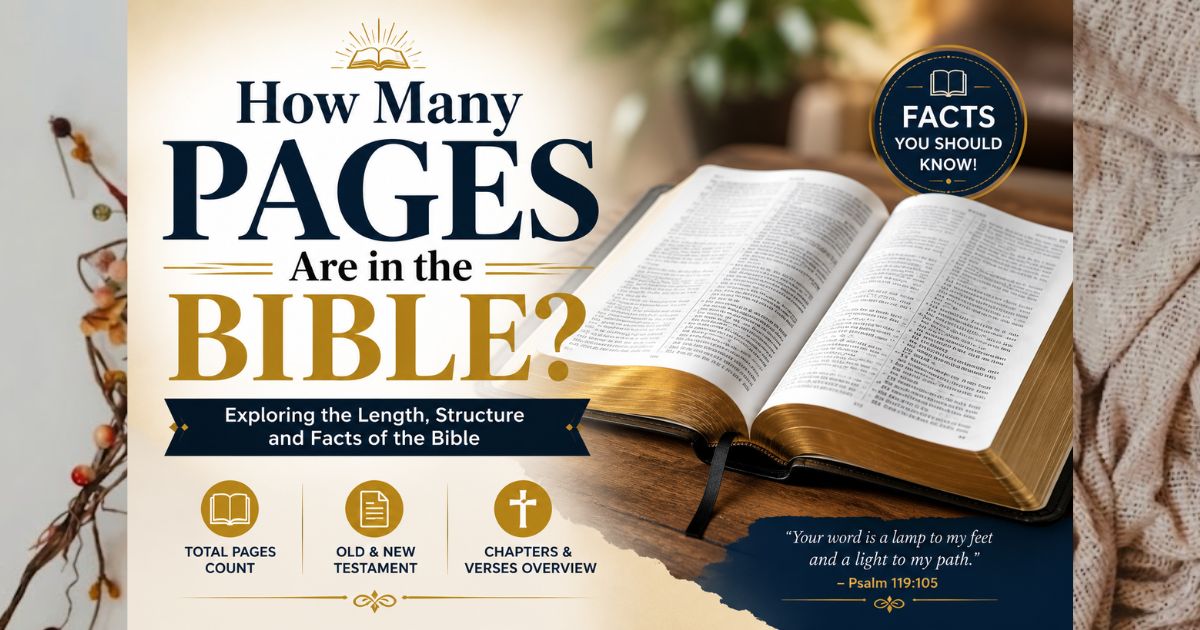
One of the most commonly asked questions about Scripture: how many pages are in the Bible? Most standard print Bibles fall within a well-established range, and understanding why that number varies tells you a great deal about the Bible’s structure, history, and translation.
This complete guide answers the question thoroughly, breaks down the Bible’s contents by Testament, and explains everything you need to know about the size, scope, and depth of the world’s most widely read book.
How Many Pages Are in the Bible?
The average standard print Bible contains between 1,200 and 1,800 pages. Most popular editions including the King James Version (KJV), New International Version (NIV), and English Standard Version (ESV) fall within this range when printed in a standard readable font.
| Bible Edition | Approximate Page Count |
|---|---|
| King James Version (KJV) — Standard Print | 1,200 – 1,400 pages |
| New International Version (NIV) | 1,100 – 1,300 pages |
| English Standard Version (ESV) | 1,200 – 1,500 pages |
| New Living Translation (NLT) | 1,100 – 1,400 pages |
| Study Bible (with notes) | 2,000 – 2,800 pages |
| Large Print Bible | 1,800 – 2,500 pages |
| Pocket/Compact Bible | 800 – 1,000 pages |
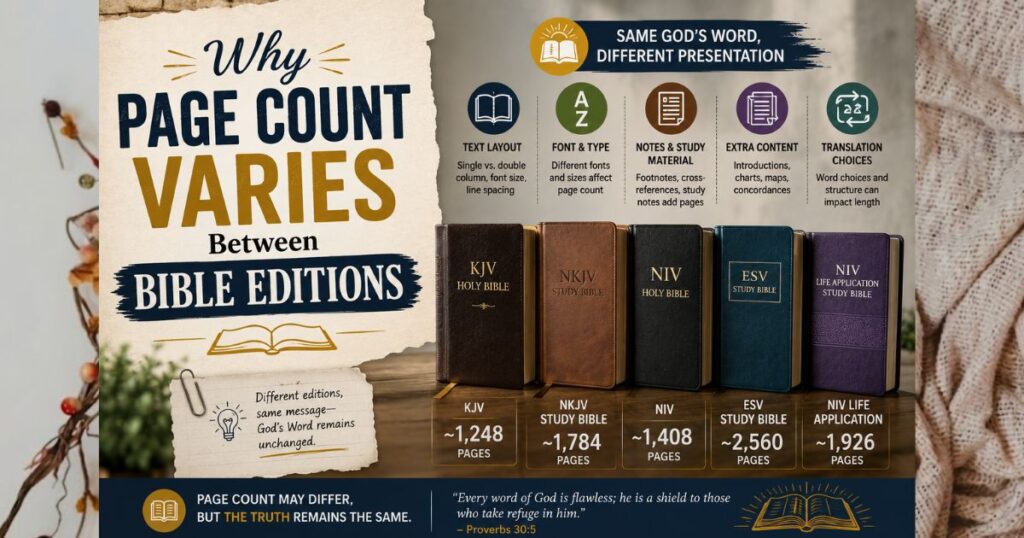
These numbers shift depending on formatting choices made by the publisher column width, line spacing, margins, and font size all affect the final page count without changing a single word of the text itself.
Read Also : 40 Bible Verses About Loyalty That Inspire Faithfulness
How Many Books, Chapters, and Verses Are in the Bible?
Before counting pages, it helps to understand what the Bible actually contains structurally.
| Category | Count |
|---|---|
| Total books in the Protestant Bible | 66 |
| Books in the Old Testament | 39 |
| Books in the New Testament | 27 |
| Total chapters | 1,189 |
| Total verses | 31,102 |
| Total words (KJV) | approximately 783,137 |
The Catholic Bible contains 73 books, adding 7 deuterocanonical books to the Protestant canon. The Ethiopian Orthodox Bible includes even more, totaling 81 books. These additional books naturally increase the page count in Catholic and Orthodox editions.
Old Testament Pages vs. New Testament Pages
The Old Testament contains 39 books and accounts for roughly 75–77% of the entire Bible’s content. It covers creation, the history of Israel, the Law, the Psalms and wisdom literature, and the writings of the major and minor prophets. In a standard print Bible, the Old Testament typically runs between 900 and 1,100 pages.
The New Testament contains 27 books and makes up approximately 23–25% of the Bible. It covers the life of Jesus Christ, the early church, the letters of the apostles, and the book of Revelation. In most print editions, the New Testament runs between 250 and 400 pages.
This size difference is why finding the middle of the Bible often surprises people the midpoint falls around the book of Psalms, deep in the Old Testament rather than anywhere near the middle of the shelf.
Read Also: 70+ Bible Verses for Healthcare Workers and First Responders
The Longest and Shortest Books in the Bible
Understanding which books take up the most space helps explain why page counts shift across editions that arrange or format certain sections differently.
| Book | Chapters |
|---|---|
| Psalms | 150 |
| Isaiah | 66 |
| Jeremiah | 52 |
| Genesis | 50 |
| Ezekiel | 48 |
| Numbers | 36 |
| Exodus | 40 |
Shortest Books by Verse Count
| Book | Verses |
|---|---|
| 3 John | 14 |
| 2 John | 13 |
| Philemon | 25 |
| Obadiah | 21 |
| Jude | 25 |
The longest chapter in the Bible is Psalm 119 with 176 verses entirely devoted to the beauty and power of God’s Word. The shortest chapter is Psalm 117 with just 2 verses.
Psalm 117:1-2 “Praise the Lord, all you nations; extol him, all you peoples. For great is his love toward us, and the faithfulness of the Lord endures forever. Praise the Lord.”
Why Page Count Varies Between Bible Editions
Many people are surprised to discover that two Bibles sitting side by side on a shelf both containing the exact same translation can have page counts that differ by hundreds of pages. Several factors explain this.
Font Size and Style
A Bible printed in 8-point font will be far shorter than the same text in 12-point font. Large print Bibles designed for older readers or those with vision difficulties can double the page count of a standard edition simply by increasing the text size.
Single Column vs. Double Column Layout
Most traditional Bibles use a double-column layout, which fits more text per page. Some modern editions use a single-column layout that reads more like a novel these editions are typically longer in page count but easier for continuous reading.
Study Notes and Commentary
A standard Bible contains only the Scripture text. A study Bible adds footnotes, cross-references, theological commentary, maps, charts, concordances, and introductions to every book. A quality study Bible can easily reach 2,500 pages or more.
Translation Style
Word-for-word translations like the ESV and NASB tend to be slightly longer because they preserve more of the original Hebrew and Greek structures. Thought-for-thought translations like the NLT or The Message use more natural English phrasing, which sometimes takes more words to express the same idea and sometimes fewer.
Paper Thickness
Bible paper is specially manufactured to be very thin while remaining opaque. Thicker paper increases the physical size of the Bible without any change in content.
Read Also: 50+ Church Anniversary Bible Verses And Scriptures
How Many Pages Are in the Old Testament Specifically?
The Old Testament spans an enormous range of literary styles law, history, poetry, prophecy, and wisdom literature and its 39 books vary widely in length.
- Torah (Genesis to Deuteronomy): approximately 200–250 pages
- Historical Books (Joshua to Esther): approximately 250–300 pages
- Wisdom and Poetry (Job to Song of Solomon): approximately 150–200 pages
- Major Prophets (Isaiah to Daniel): approximately 200–250 pages
- Minor Prophets (Hosea to Malachi): approximately 80–100 pages
Together, the Old Testament in a standard print Bible runs approximately 900 to 1,100 pages.
Read Also: 40 Bible Verses About Loyalty That Inspire Faithfulness
How Many Pages Are in the New Testament Specifically?
The New Testament is shorter but theologically dense, covering the life of Christ and the foundation of the Christian church.
- Gospels (Matthew, Mark, Luke, John): approximately 120–160 pages
- Acts of the Apostles: approximately 40–50 pages
- Paul’s Letters (Romans to Philemon): approximately 80–100 pages
- General Letters (Hebrews to Jude): approximately 40–50 pages
- Revelation: approximately 25–35 pages
Together, the New Testament typically runs approximately 250 to 400 pages in a standard print Bible.
What Does the Bible Say About Its Own Words?
Scripture speaks powerfully about the nature and value of God’s written word and these verses give the page count its true meaning.
2 Timothy 3:16-17 “All Scripture is God-breathed and is useful for teaching, rebuking, correcting and training in righteousness, so that the servant of God may be thoroughly equipped for every good work.”
Psalm 119:105 “Your word is a lamp for my feet, a light on my path.”
Hebrews 4:12 “For the word of God is alive and active. Sharper than any double-edged sword, it penetrates even to dividing soul and spirit, joints and marrow; it judges the thoughts and attitudes of the heart.”
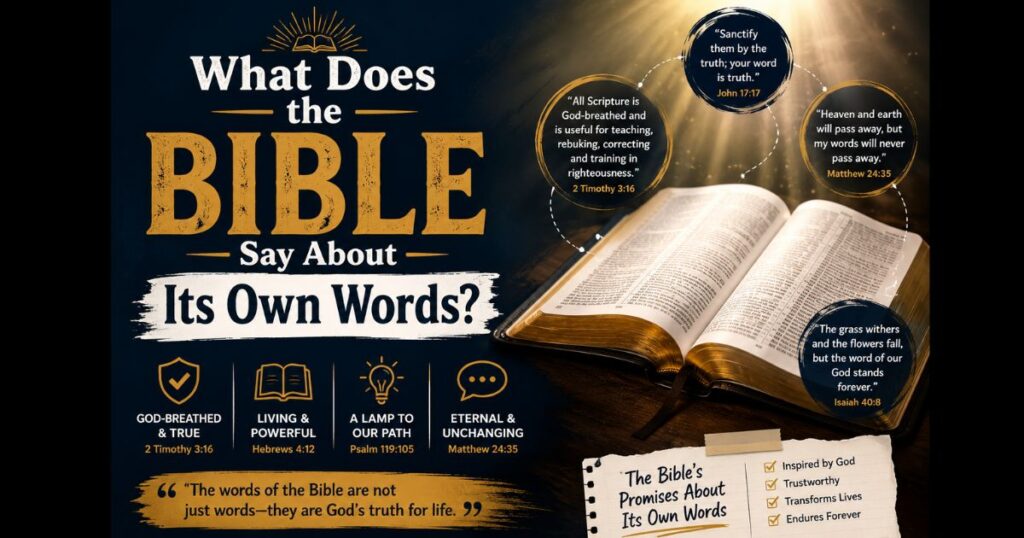
Matthew 24:35 “Heaven and earth will pass away, but my words will never pass away.”
Isaiah 40:8 “The grass withers and the flowers fall, but the word of our God endures forever.”
Proverbs 30:5 “Every word of God is flawless; he is a shield to those who take refuge in him.”
Deuteronomy 8:3 “Man does not live on bread alone but on every word that comes from the mouth of the Lord.”
Psalm 119:160 “All your words are true; all your righteous laws are eternal.”
Read Also: 50+ Top Bible Verses About Family Problems In 2026
How Does the Catholic Bible Differ in Page Count?
The Catholic Bible includes 73 books seven more than the Protestant 66-book canon. These additional books, known as the deuterocanonical books, are:
- Tobit
- Judith
- 1 Maccabees
- 2 Maccabees
- Wisdom of Solomon
- Sirach (Ecclesiasticus)
- Baruch
Conclusion
The question of how many pages are in the Bible does not have one fixed answer but it has a clear and honest one. Most standard print Bibles contain between 1,200 and 1,800 pages, depending on the edition, translation, font size, and layout. Study Bibles can exceed 2,800 pages.
Pocket editions compress the same text into 800. What never changes is the content itself 66 books, 1,189 chapters, and over 31,000 verses that have guided, challenged, and transformed billions of lives across thousands of years.
Many pages your Bible has, what matters most is not the count it is how deeply those pages are read, studied, and lived.
Frequently Asked Questions
How Many Pages Are In The King James Bible?
A standard King James Version (KJV) Bible typically contains between 1,200 and 1,400 pages in a regular print edition. Large print KJV Bibles can reach 2,000 or more pages, while compact or pocket editions may contain as few as 800 pages.
How Many Pages Are In The New Testament Alone?
The New Testament contains 27 books and typically runs between 250 and 400 pages in a standard print Bible. The exact count varies by edition and font size, but most readable-format New Testaments fall within this range.
Does A Catholic Bible Have More Pages Than A Protestant Bible?
Yes. The Catholic Bible contains 73 books compared to the Protestant 66, adding seven deuterocanonical books. This typically adds 100 to 150 additional pages, bringing most Catholic Bible editions to between 1,300 and 1,900 pages in a standard print format.